 blog
blog
Solar Panel Cleaning Cost Analysis: 2026 Price Guide
Table of Contents
- Why a Solar Panel Cleaning Cost Analysis Matters
- The Three Pricing Models Behind Professional Solar Panel Cleaning Prices
- Solar Panel Cleaning Cost Per Panel: What Drives the Number
- Residential vs. Commercial Systems: How Pricing Scales
- How Often to Clean Solar Panels (and What Frequency Costs)
- Solar Panel Cleaning ROI: When the Math Works
- Getting an Accurate Solar Panel Cleaning Service Quote
- Conclusion
- Frequently Asked Questions
Last Updated: October 7, 2026
Why a Solar Panel Cleaning Cost Analysis Matters
A solar panel cleaning service cost analysis compares what you pay for professional cleaning against the energy output you recover.
At EverClean Exterior Cleaning, we've found that panels that look "fine" from the ground are often coated in a film of dust, pollen, and hard water spots that quietly drags down production.
Below, we break down the three pricing models, what drives the number, and how to decide if cleaning pays for itself.
The Three Pricing Models Behind Professional Solar Panel Cleaning Prices
Professional solar panel cleaning prices follow three basic models, and knowing which one you're quoted changes how you compare bids.
Per-Panel Pricing
The provider charges a set rate per panel, so a 20-panel system costs roughly twice a 10-panel system. This model is easy to audit.
Flat-Rate and Minimum Service Charges
A single flat fee covers the visit regardless of panel count, usually with a minimum service charge. Flat rates favor larger arrays; on a small system, the minimum charge can make the per-panel equivalent look steep.
Square-Foot and Array-Based Pricing
Here the quote is based on total array area or the full system as a unit. It suits commercial rooftops where panel counts run into the hundreds.
| Pricing Model | How It's Calculated | Best For |
|---|---|---|
| Per-panel | Set rate × number of panels | Residential systems, easy comparison |
| Flat-rate | One fee per visit, plus minimum charge | Larger arrays, predictable budgeting |
| Square-foot / array | Total area or full system | Commercial rooftops, complex layouts |
Solar Panel Cleaning Cost Per Panel: What Drives the Number
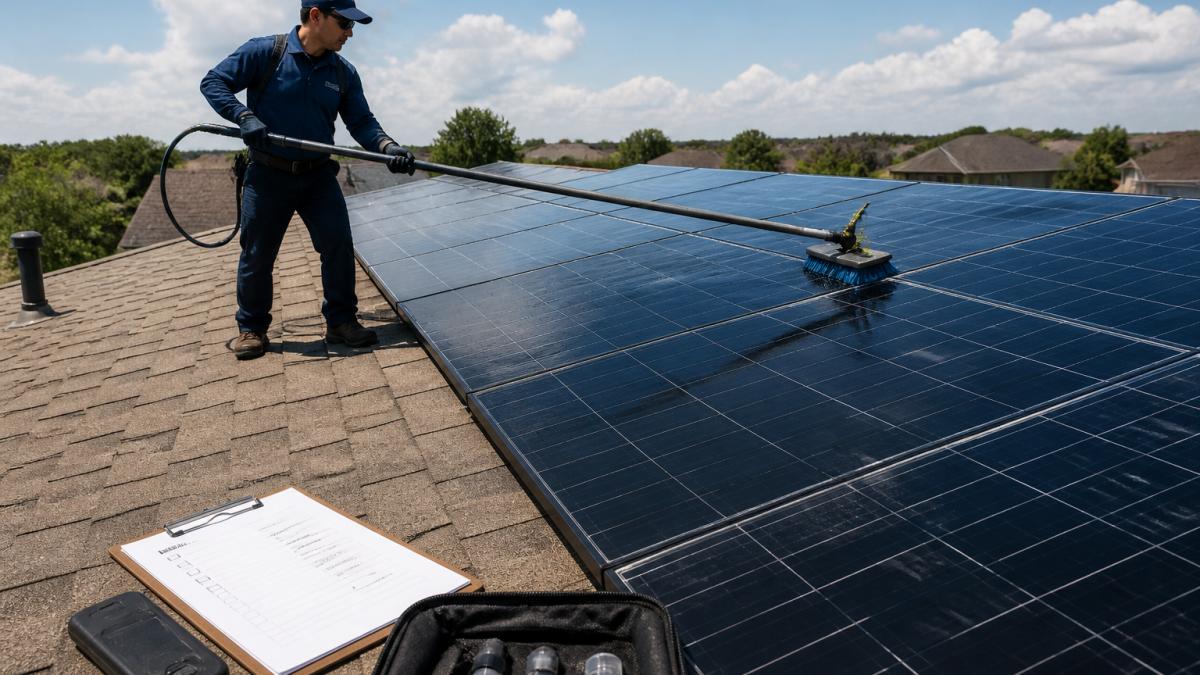
Solar panel cleaning cost per panel is not fixed. It moves with system size, roof access, site conditions, and crew travel, two identical arrays on the same street can quote differently because one sits under a tree.
System Size, Panel Count, and Array Layout
Bigger arrays usually mean a lower cost per panel, because fixed costs get spread across more units. A tight, easily reached array is faster to clean than panels split across two roof planes. The per-panel rate on a 30-panel array is meaningfully lower than on a 10-panel array from the same provider, since setup and teardown time is nearly identical.
Roof Access, Pitch, and Site Conditions
Steep pitch, multi-story height, and fragile roofing materials all slow a crew down, and slow work costs more, the biggest reason two quotes for the same panel count differ. A ground-mount or single-story, low-pitch roof is cheapest; a three-story roof with steep pitch, tile or slate, and limited ladder placement adds substantial labor time as a higher base rate or access surcharge.
Labor, Travel, and Mobilization Fees
Labor is the core of any quote. Travel and mobilization fees cover getting the crew and equipment to your property; demobilization covers packing out. Some providers fold these into the base rate, others list them separately, neither is wrong, but you need to know which you're looking at.
The Fee Line Items That Actually Move the Quote
When comparing two quotes, put them side by side against this list. A quote silent on a line item isn't necessarily cheaper; it may bill that item later as a change order.
| Fee Line Item | What It Covers | How It Typically Appears |
|---|---|---|
| Base service rate | Labor and standard equipment for a typical array | Headline price |
| Minimum service charge | Floor price for small jobs | Flat add-on or built into base |
| Per-panel or per-array rate | Scaling with system size | Multiplier on base |
| Travel / mobilization | Crew and equipment transport | Flat fee or per-mile |
| Roof access surcharge | Steep pitch, height, fragile roofing | Percentage or flat add-on |
| Water treatment | Purified or deionized water for hard-water areas | Per-visit or per-gallon |
| Add-on services | Bird-proofing, critter guard, gutter clearing, inspection report | Quoted separately |
| Recurring plan discount | Lower per-visit rate for scheduled service | Percentage off one-time rate |
How to Compare a Per-Panel Quote to a Flat-Rate Quote
The only honest way to compare pricing models is to convert everything to a per-panel figure. Take the flat-rate quote, add any separately listed travel, access, or water fees, and divide by the panel count. Do the same with the per-panel quote, including its minimum charge.
Regional Pricing Methodology
Isolated local examples hide the variables that actually set price. Four inputs drive regional differences:
- Local labor rates. Crew wages and overhead vary widely by market, and labor is the largest cost component.
- Climate and dust load. High-pollen, agricultural, or wildfire-smoke regions see more frequent cleaning and higher soiling rates, which supports higher recurring pricing.
- Water availability and restrictions. In areas with watering restrictions or hard water, providers must truck in or treat water, which adds a real per-visit cost.
A quote that looks high in one market may be normal in another once these four inputs are accounted for, which is why a national average is a weak benchmark and a regional methodology a stronger one.
Residential vs. Commercial Systems: How Pricing Scales
Residential systems are priced for a single visit and roof; commercial systems for scale, scheduling, and documentation.
A residential array typically involves one crew, one access point, and a job measured in hours.
If you own a rental property, treat it like a small commercial job: ask for recurring scheduling and a written scope so turnover cleaning doesn't get skipped.
How Often to Clean Solar Panels (and What Frequency Costs)
How often to clean solar panels depends on what's landing on them. In most residential settings, once or twice a year is enough. Under heavy pollen, dust, or bird traffic, quarterly cleaning keeps production steadier.
Quarterly Cleaning vs. Annual Cleaning
Quarterly service costs more per year but keeps the array closer to peak output. Annual cleaning is cheaper up front and fine for clean, rural, rain-washed roofs. The right answer depends on your soiling rate, not a generic rule.
Dust, Pollen, Bird Droppings, and Hard Water
Dust and pollen build an even film that dims the whole array. Bird droppings create hot spots that can damage cells over time. Hard water leaves mineral spots a dry brush won't remove, and needs purified water rather than a garden hose.
Solar Panel Cleaning ROI: When the Math Works
Solar panel cleaning ROI comes down to one comparison: the value of the extra energy you produce versus the cost of the visit. The answer changes with your soiling rate, electricity rate, and how your utility compensates exported power.
Step 1: Estimate Your Soiling Loss
Soiling loss is the percentage of production your array gives up to dirt, dust, pollen, bird droppings, and water spots.
You can sanity-check your number without instruments: compare a month of production on your monitoring app against the same month last year, or a neighbor's unshaded array of similar size.
Step 2: Convert That Loss Into Dollars
Use this formula:
Annual recovered value = System size (kW) × Production per kW per year (kWh) × Soiling loss (%) × Value per kWh ($)
Production per kW per year varies by region and tilt, but a common residential range is roughly 1,200 to 1,600 kWh per kW of capacity. Your utility's rate schedule is the value-per-kWh input; on a time-of-use plan, use your blended or solar-hours rate rather than the headline peak rate.
Step 3: Worked Example
Assume a 7 kW residential array producing 1,400 kWh per kW per year, a 6% soiling loss, and a $0.16 per kWh value:
- Annual production: 7 kW × 1,400 kWh = 9,800 kWh
- Energy lost to soiling: 9,800 kWh × 6% = 588 kWh
- Recovered value if fully cleaned: 588 kWh × $0.16 = about $94 per year
Compare that $94 to the cleaning quote. If a visit costs $150 and you clean once a year, cleaning doesn't pay back on energy alone at a 6% loss. At a 12% loss, recovered value roughly doubles to about $188, and an annual $150 visit clears the bar.
Step 4: Add the Non-Energy Variables
The pure energy calculation understates the case in some situations and overstates it in others.
- Net metering and export rates. If your utility credits exported power at the full retail rate, recovered production is worth the full $0.16. If you are on a lower export or avoided-cost rate, recovered production is worth less, and the payback stretches out.
- Demand charges (commercial). On a commercial account with demand charges, shaving peak load can be worth more than the energy line item alone.
- Hot spots and cell damage. Bird droppings and concentrated debris can create localized hot spots. Over time, sustained hot spots can degrade cells, which is a repair cost rather than an energy cost. This is the strongest argument for cleaning arrays that are otherwise only marginally economic.
When Cleaning Rarely Pays
Be honest about the losing cases. A gently pitched array in a rainy, low-dust region with no tree cover or bird traffic often self-cleans well enough that a paid visit is hard to justify on energy alone. There, cleaning is a cosmetic or inspection decision, not a financial one, saying so beats pretending every array needs quarterly service.
DIY Cleaning vs. Hiring a Professional
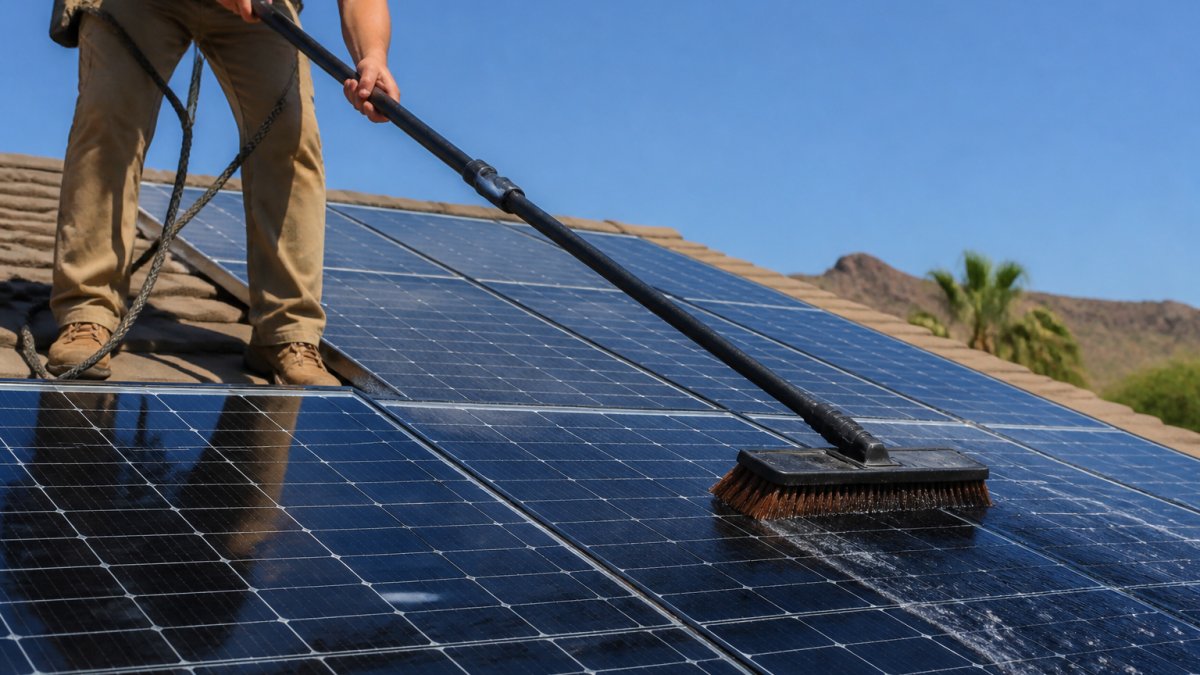
DIY cleaning saves the service fee but introduces real risk. Roof work is the leading hazard, and the wrong brush or water source can scratch glass or leave mineral spots. Professional cleaning brings the right tools, purified water, soft brushes, and insurance if something goes wrong on the roof.
| Approach | Upfront Cost | Main Risk | Best For |
|---|---|---|---|
| DIY cleaning | Low (supplies only) | Roof falls, scratched glass, warranty issues | Ground-level, easily reached arrays |
| Professional cleaning | Service fee per visit | None to you if the provider is insured | Steep roofs, hard water, large arrays |
Getting an Accurate Solar Panel Cleaning Service Quote
An accurate quote starts with a site inspection. A provider who quotes without seeing your array is guessing, and guesses turn into change orders.
Use this checklist when you request a quote:
- Confirm the pricing model (per-panel, flat-rate, or square-foot)
- Ask whether travel, mobilization, and demobilization fees are included
- Confirm there is no hidden minimum service charge
A transparent provider answers every line without hesitation. If a quote can't survive this checklist, keep looking.
Conclusion
Comparing solar panel cleaning service cost analysis across providers is harder than it should be, because most quotes hide the fees that matter. At EverClean Exterior Cleaning, we quote solar panel care with honest, upfront pricing, send background-checked, uniformed technicians who never subcontract, and back every job with a 48-hour satisfaction guarantee.
Frequently Asked Questions
How much does it cost to have solar panels professionally cleaned?
Professional solar panel cleaning prices vary by region, system size, and pricing model. Providers typically charge per panel, per visit with a minimum service charge, or by square footage. Most quotes include labor, purified water, and equipment, but travel fees, mobilization fees, and roof-access surcharges can add to the total. Because rates shift with local labor costs and site conditions, request an itemized quote from a local provider rather than relying on a national average.
Do solar panel cleaning companies charge per panel or per visit?
Both models exist. Per-panel pricing scales with system size and works well for larger arrays, while flat per-visit pricing often includes a minimum service charge that covers travel and setup. Some providers use square-foot pricing for commercial systems. Ask which model applies to your roof before booking, and confirm whether the quote includes demobilization fees, water sourcing, or a recurring service plan discount.
How often should solar panels be cleaned?
Cleaning frequency depends on your site conditions. Homes near farmland, unpaved roads, or heavy tree cover may need quarterly cleaning, while panels in areas with regular rainfall and low dust often stay productive with annual or twice-yearly service. Bird droppings and hard water stains should be addressed promptly because they block light unevenly and can etch glass over time. A site inspection helps a provider recommend the right schedule.
Is professional solar panel cleaning worth the cost?
The solar panel cleaning ROI depends on how much soiling is reducing your power output and what you pay per kilowatt-hour. If dust, pollen, or bird droppings are noticeably cutting production, cleaning can restore output and improve energy savings over the system's life. DIY cleaning saves money but carries roof-access risk and can void warranties if the wrong method or pressure is used. Weigh the cleaning cost against your production increase and electricity rate.