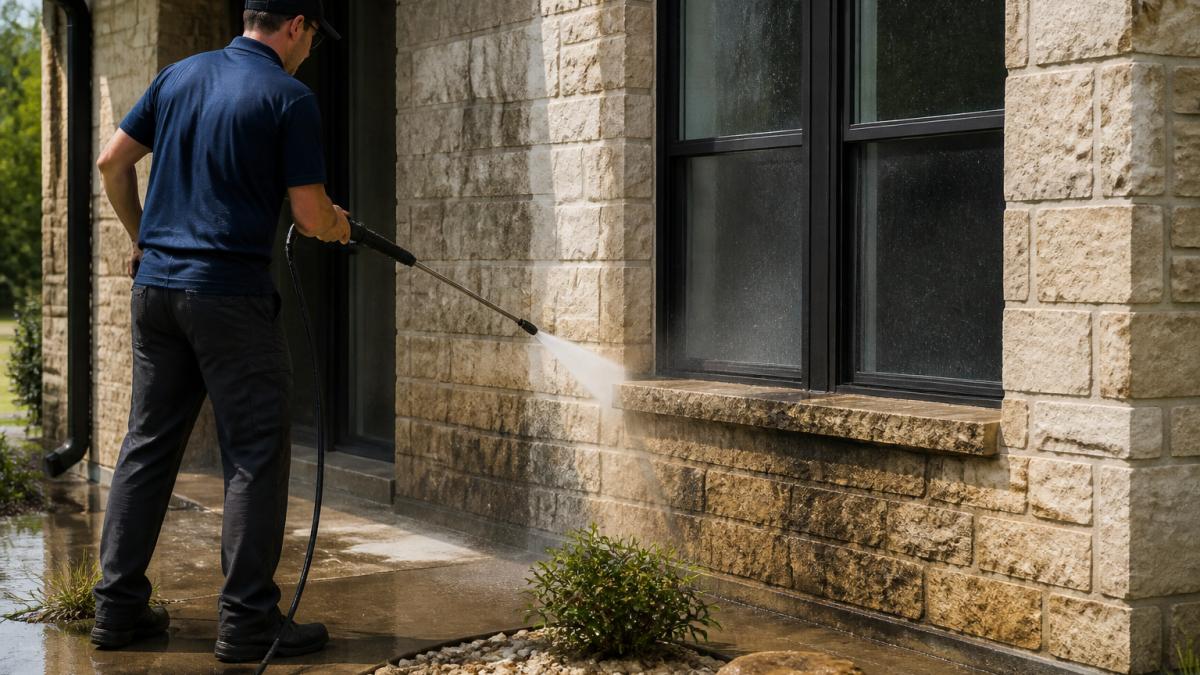
 comparison
Soft Washing vs Pressure Washing Stone: Safe Cleaning Guide
Table of Contents
- Soft Washing vs Pressure Washing Stone: Key Differences
- Pressure Washing Stone PSI Settings and Nozzle Selection
- Soft Wash Chemical Solutions for Stone That Won't Cause Damage
- Stone Cleaning Best Practices for Long-Lasting Results
- Stone-Specific Damage Risks: What Pressure Washing Can Ruin
- Maintenance Schedules and Visual Identification Guide
- Frequently Asked Questions
Last Updated: October 4, 2026
Soft Washing vs Pressure Washing Stone: Key Differences
Choosing between soft washing vs pressure washing stone comes down to one factor: how much force the surface can survive. Pressure washing stone uses high-pressure water, typically 1,500 to 4,000 PSI, to blast away dirt. Soft washing uses low pressure, usually under 500 PSI, paired with cleaning solutions that dissolve grime. At EverClean Exterior Cleaning, we treat that as the starting point. The real deciding factors are stone type, age, and existing damage.
Pressure washing stone works well on durable, unsealed surfaces like concrete pavers and certain granites. Soft washing suits limestone, sandstone, and older masonry where high-pressure water can pit, etch, or crack the surface.
Below, we break down both methods, explain PSI and GPM, and show you how to match the right approach to your stone.
What Is Pressure Washing?
Pressure washing is a cleaning method that uses a motorized pump to push water through a narrow nozzle at high velocity, stripping dirt, mold, and stains from hard surfaces. Most consumer machines run between 1,500 and 4,000 PSI, with water volume measured in gallons per minute, or GPM.
Cleaning power comes from pressure and water volume combined. A 3,000 PSI / 2.0 GPM machine moves far less water than a 2,500 PSI / 4.0 GPM unit, and the higher-volume unit often cleans faster on large flatwork.
Pressure washing stone delivers fast results on concrete, brick, and durable pavers, removing years of embedded grime in a single pass. The trade-off is risk: on the wrong surface, that force causes etching, substrate damage, and surface loss.
What Is Soft Washing?
Soft washing is a low-pressure cleaning method that relies on biodegradable cleaning solution, surfactants, and chemical dwell time to break down organic growth, followed by a gentle rinse cycle. Pressures stay below 500 PSI, often closer to a garden hose with added reach.
The chemistry does the work: surfactants lift dirt, while sodium hypochlorite or similar agents kill algae, lichen, and mold spores at the root instead of just blasting away visible growth.
For natural stone, this matters. Soft washing preserves surface integrity because it never forces water into pores or strips the stone's natural binder. It takes longer, and results depend on correct dwell time, but on limestone, sandstone, and older masonry, that patience pays off.
| Factor | Pressure Washing | Soft Washing |
|---|---|---|
| Pressure range | 1,500-4,000 PSI | Under 500 PSI |
| Best for | Concrete, brick, durable pavers | Limestone, sandstone, older masonry |
| Cleaning agent | Water force | Surfactants and cleaning solution |
| Main risk | Etching, pitting, substrate damage | Streaking if dwell time is wrong |
| Typical dwell time | None | 5-15 minutes before rinse |
How to Tell Which Method Your Stone Needs
Start with a simple test: press a fingernail into a hidden corner. If it scratches easily, the stone is soft and needs low-pressure application. If it resists, it can likely handle higher pressure.
Next, check the surface. Chalky residue, pitting, or flaking edges signal a stone already weakened. Pressure washing stone in that condition accelerates the damage.
Finally, identify the stone type. Granite, slate, and dense travertine tolerate moderate pressure. Limestone, sandstone, and anything with a honed or aged finish call for soft washing.
If unsure, default to soft washing. It is nearly always safer, and a professional can step up the pressure if the stone proves durable.
Pressure Washing Stone PSI Settings and Nozzle Selection
Getting PSI right is where most DIY stone cleaning goes wrong. The safe range depends on the stone, but a few rules hold.
For durable stone like granite or slate, stay between 1,500 and 2,000 PSI. For concrete pavers, 2,000 to 2,500 PSI is usually enough. Never exceed 3,000 PSI on any natural stone surface.
Nozzle tips matter as much as the machine setting. The wrong tip concentrates force into a tiny area and cuts into stone like a blade.
- White tip (40 degrees): widest spray, safest for natural stone
- Green tip (25 degrees): moderate concentration, use on concrete only
- Yellow tip (15 degrees): narrow spray, avoid on stone entirely
- Red tip (0 degrees): pinpoint stream, never use on any masonry
Keep the wand moving at a consistent distance, roughly 30 to 45 centimeters from the surface. Stopping in one spot, even briefly, leaves a permanent etch mark.
Soft Wash Chemical Solutions for Stone That Won't Cause Damage
The right cleaning solution does more for stone than any pressure setting. Match the chemistry to the stain, not the reverse.
For organic growth like algae, lichen, and mold spores, a diluted sodium hypochlorite mix with a surfactant is standard. The surfactant helps the solution cling to vertical surfaces and penetrate porous stone instead of running off.
For greasy or oil-based stains, a degreasing agent formulated for masonry works better than bleach. Bleach does not break down oils, and using it on a grease stain just wastes a cycle.
For general grime on delicate stone, a pH-neutral cleaner is the safest starting point. It will not react with the stone's minerals or strip sealant.
Whatever you choose, test it on a small hidden area first: apply, let it dwell, rinse, and check for discoloration. Never mix bleach with acid-based cleaners, the combination releases toxic gas (the CDC).
Biodegradable cleaning solutions have improved significantly, many now matching traditional products on performance while breaking down safely in soil and runoff.
Stone Cleaning Best Practices for Long-Lasting Results
Good technique protects stone for years. A few habits separate a lasting clean from a surface that looks worn within months.
Always pre-wet surrounding areas and nearby plants. Runoff carries cleaning solution, and pre-wetting dilutes it before it damages landscaping.
Work in sections, top to bottom: clean, rinse thoroughly, then move on. Letting solution dry on stone leaves hard-to-remove streaks.
After cleaning, let the stone dry completely, then apply a breathable sealer. Sealing blocks water absorption without trapping moisture inside, the balance that keeps stone stable through freeze-thaw cycles.
- Pre-wet plants and surrounding surfaces before you start
- Apply solution from the bottom up, rinse from the top down
- Keep chemical dwell time within the product's stated range
- Rinse twice on porous stone to flush residue from pores
- Seal within a week of cleaning for best absorption
Stone-Specific Damage Risks: What Pressure Washing Can Ruin
Stone does not fail in one way.
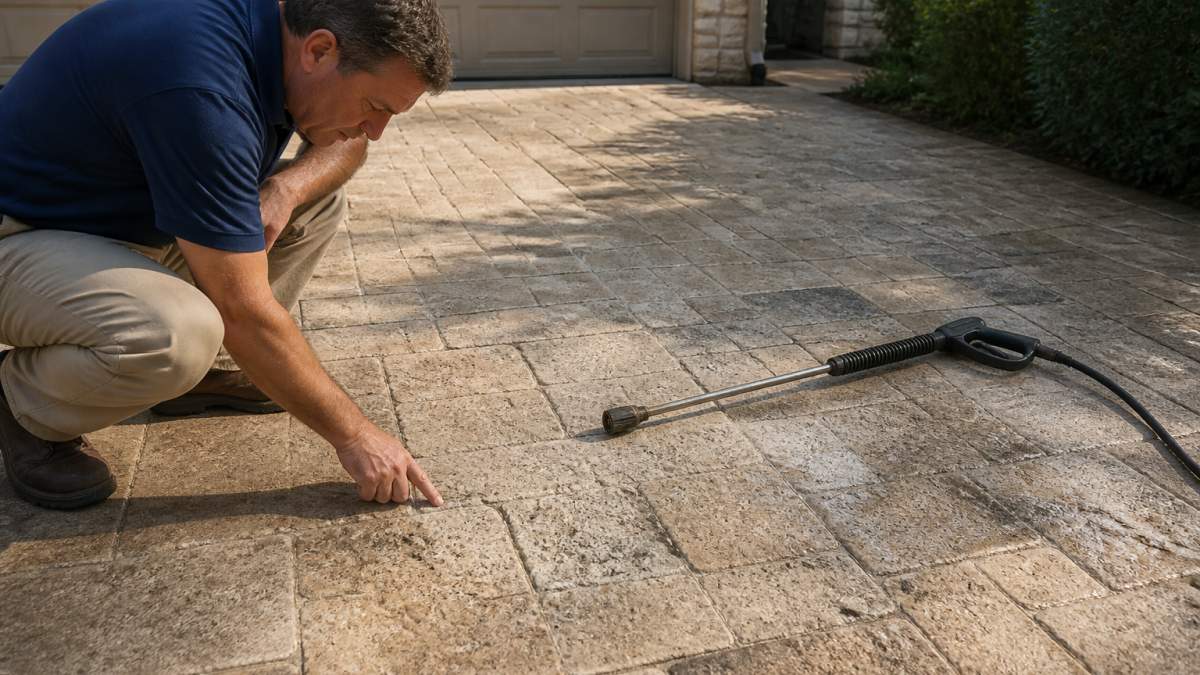
Limestone: dissolution and pore expansion.
Limestone is calcium carbonate, which explains almost every way it fails.
Sandstone: binder loss and grain release.
Sandstone is quartz and feldspar grains held together by a mineral cement, often silica, calcite, or iron oxide. Pressure washing attacks the cement, not the grains.
Slate: cleavage-plane wedging.
Slate is foliated, splitting along parallel planes. Pressure applied at an angle forces water into the seams, and freeze-thaw cycles widen them. The result is flaking tile edges and a rough, delaminating face.
Granite: generally safe, with two exceptions.
Granite's interlocking crystal structure makes it the most pressure-resistant natural stone.
Travertine: void collapse and acid sensitivity.
Unfilled travertine is full of natural channels and voids. Pressure forces water in, and the stone holds it; in cold climates that trapped water freezes and spalls the surface from inside.
Older masonry and mortar joints: the hidden weak point.
On any stone wall or patio with mortar joints, the mortar is usually softer than the stone.
The chemistry side of damage.
Pressure is only half the risk. Cleaning solutions react with stone and sealants in ways not always visible on cleaning day.
- Sodium hypochlorite (bleach) at soft wash concentrations is generally safe on granite, slate, and unsealed sandstone, but it can cloud film-forming acrylic and polyurethane sealers and will yellow some wax-treated travertine.
- Acid-based cleaners (oxalic, citric, muriatic) dissolve calcium carbonate. That means they are off-limits on limestone, travertine, and marble, and they will etch the cement binder in sandstone.
- High-pH alkaline cleaners can dull polished finishes and strip wax sealers, but they are usually safe on unpolished natural stone.
- Mixing bleach with acid releases chlorine gas, a genuine health hazard, not just a surface risk.
A common pattern: a homeowner pressure washes a limestone patio, sees immediate brightening, then notices within months that the stone stains faster and looks duller than before.
Maintenance Schedules and Visual Identification Guide
The right maintenance schedule depends on your climate and how much shade your stone gets. Shaded, damp areas grow algae faster and need more frequent attention.
For most homes, a light soft wash once a year prevents organic growth from taking hold. Homes with heavy tree cover or constant shade may need twice-yearly cleaning.
Here is how to identify what your stone needs at a glance:
- Green or black film: algae or mold, treat with soft wash and surfactant
- Orange or rust-colored streaks: mineral staining, needs a specialized remover
- White chalky powder: efflorescence, often a moisture issue, not just dirt
- Gray-green patches with texture: lichen, which needs longer dwell time to kill at the root
- Dark spots that do not rinse away: deep-set organic staining, may need repeat treatment
Check your stone after each rainy season. Catching growth early means a lighter clean and less risk to the surface.
If you would rather not manage the chemistry and pressure settings yourself, that is where professional help pays off. EverClean Exterior Cleaning handles soft washing and pressure washing stone with background-checked, uniformed technicians who never subcontract the work. We offer honest, upfront pricing and a 48-hour satisfaction guarantee.
Frequently Asked Questions
Is soft washing better than pressure washing for natural stone?
For most natural stone, soft washing is the safer choice. It uses low pressure (under 500 PSI) and relies on biodegradable cleaning solutions to break down algae, mold spores, and lichen without etching the surface. Pressure washing stone can force water into pores, causing spalling or substrate damage. However, if your stone is nonporous and in good condition, a carefully controlled pressure wash with the right nozzle tips may be acceptable.
How many PSI is considered soft wash for stone surfaces?
Soft washing for stone typically stays below 500 PSI, often in the 100-300 PSI range. The goal is to apply cleaning solution at low pressure, let it dwell, then rinse gently. For comparison, pressure washing stone PSI settings usually run 1,200-2,500 PSI depending on the stone type. Always test a small area first and avoid zero-degree nozzle tips.
What cleaning solutions are used in soft washing stone?
Soft wash chemical solutions for stone often include sodium hypochlorite (diluted), surfactants, and sometimes a mild degreaser. These break down organic growth and dirt. For acid-sensitive stone like limestone, avoid acidic cleaners. Always use biodegradable options and follow dwell time recommendations. Rinse thoroughly with low pressure to prevent chemical residue.
How often should stone surfaces be professionally cleaned?
Most stone surfaces benefit from professional cleaning every 12-18 months. High-traffic areas or stone under trees may need cleaning every 6-12 months. Regular maintenance prevents deep-set stains and algae from taking hold. A visual inspection each season helps you spot early growth. Following stone cleaning best practices extends the life of your pavers, masonry, and natural stone.
Stone damage from the wrong cleaning method is often permanent, and repairing etched limestone or eroded sandstone costs far more than cleaning it correctly the first time. EverClean Exterior Cleaning brings the right method, chemistry, and pressure settings to every job, backed by background-checked technicians, no subcontractors, and a 48-hour satisfaction guarantee. Get a free estimate and protect your stone while restoring its curb appeal.